
Informal learning accounts for over 75% of the learning taking place in organizations today.[1] Often, the most valuable learning takes place serendipitously, by random chance. Most companies, however, focus only on formal learning programs, losing valuable opportunities and outcomes. To truly understand the learning in your organization you might want to recognize the informal learning already taking place and put in practices to cultivate and capture more of what people learn. This includes strategies for improving learning opportunities for everyone and tactics for managing and sharing what you know.
This introduction is dedicated to reviewing the informal learning literature, understanding the issues, and pointing you to additional resources.
What is informal learning?
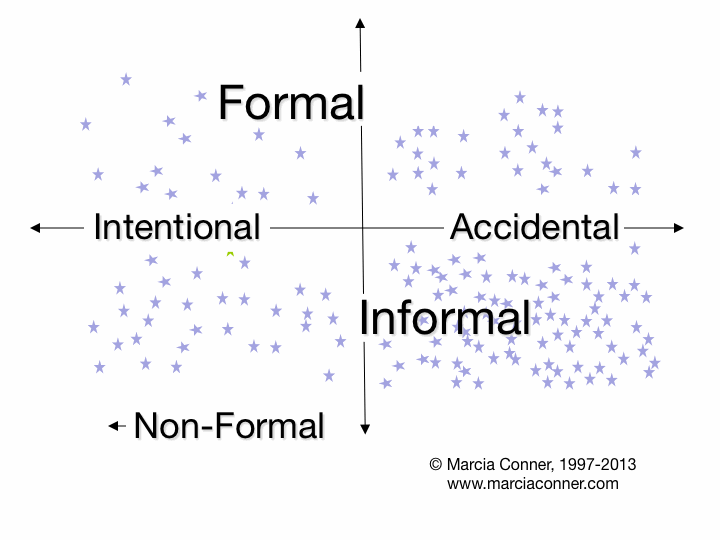
Most learning doesn’t occur during formal training programs. It happens through processes not structured or sponsored by an employer or a school. Informal learning is the term I use to describe what happens the rest of the time. In order to truly differentiate between formal and informal, I also find it valuable to examine what is learned intentionally or accidentally.

(click on the image to get a larger version of this graphic you can use in presentations)
Formal learning includes the hierarchically structured school system that runs from primary school through the university and organized school-like programs created in business for technical and professional training.
Informal learning describes a lifelong process whereby individuals acquire attitudes, values, skills and knowledge from daily experience and the educational influences and resources in his or her environment, from family and neighbors, from work and play, from the market place, the library and the mass media.
Intentional learning is the process whereby an individual aims to learn something and goes about achieving that objective.
Accidental learning happens when in everyday activities an individual learns something that he or she had not intended or expected.
I also sometimes refer to one more category: Non-formal learning. I define it is any organized educational activity outside the established formal system whether operating separately or as an important feature of some broader activity intended to serve identifiable learning objectives.
The distinctions between formal, informal, and non-formal were first developed in the 1950s by people working in the area of international development. In my experience and from the work we have done with organizations, there are far more opportunities for informal accidental learning than any other single type of learning.
(click on the image to get a larger version of this graphic you can use in presentations)
What are you learning informally?
When I ask groups, “where do you learn?” I hear the following: at work, in house, en route, on the run, in context, in situ, through search, by accident, with peers, from children, in press, across TV, by mistake, ah ha!, to escape. When I ask, “What is your favorite way to learn outside of formal programs?” I hear: reading journals or magazines, reading book(s), talking with experts, talking with peers, email or other written correspondence, and through a coach or mentor.
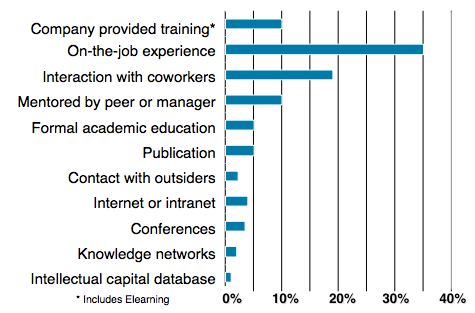
We learn at work through the following means:
What can you do to understand the informal learning in your organization?
- List all of the informal programs going on in your organization. Post that for others to add to and work with.
- Ask for employees to share informally gathered knowledge with peers in a formal way.
- Support informal communities of practice. Create others where you there are gaps.
- Look at what your meetings really offer.
- Find more opportunities for accidental learning and make it a topic of conversation.
Where can you learn more?
Fast Company Magazine’s learning resource center features an article I wrote on the informal learning theme. “Still think learning means school? Expand your definition of learning to include conversations with your peers and your children, from books, articles, informal networks, Internet searching, television, and what you learn through trial and error. Use everything that happens in your world as a resource to learn more now.” Learn More Now, Informally. Marcia L. Conner, May 2005.
I published a chapter on Informal Learning in the book Leading Organizational Learning: Harnessing the Power of Knowledge. Marshall Goldsmith, Howard Morgan, Alexander J. Ogg (editors). Leader to Leader Institute. Jossey-Bass, 2004.
In addition, here is a list of articles, websites, and research related to informal learning.
Articles
There are not many articles available on informal learning but there are some. Please let me know if you find additional articles. I’ll add to this list over time.
I wrote a piece for Fast Company in 2005 entitled, “Learn More Now” on how informal learning can support the day-in and day-out culture building and skills development needed in an economy fueled by distinctive information and sparkling innovations. I outlined 5 easy to implement steps to taking advantage of the informal learning in your organization today.
Jay Cross wrote “Informal Learning: A Sound Investment,” in October 2003 for Chief Learning Officer Magazine. I’ve worked with Jay for years and I’m thrilled some of my passion for informal learning has rubbed off on him! He also posted to his website some interesting informal learning facts and insights.
Bob Mosher wrote, “The Power of Informal Learning,” in the July 2004 Chief Learning Officer Magazine. Although more formal forms of instruction such as the classroom and e-learning will be around for years, it’s becoming more and more important to watch and harness the more informal methodologies that our students are utilizing. Most of these methods have been around for years, but have gone unnoticed by the training community.
David Grebow wrote “At the Water Cooler of Learning,” in Transforming Culture: An Executive Briefing on the Power of Learning (June 2002). He explains that we have become obsessed with formal learning in the workplace. In our zeal to learn, we have transferred the formal model of learning into the collective mind of our corporations. Even e-learning is simply less-expensive formal learning at a distance.
Dori Digenti wrote “Make Space for Informal Learning,” in Learning Circuits (August 2000). She notes that one of the ways that elearning can help us to learn more effectively is through combining the strengths of design and technology to create informal learning environments.
Steelcase’s Paul Cornell summarizes the utility of informal learning and how organizations can begin to help the process along by creating both opportunities and online environments that support the meeting of people for new knowledge creation.
Michele B. Medved wrote, “Creating an environment for ongoing learning,” in Learning Circuits (May 2003). You will need to register to read this article, but it is free of charge.
“Our Shared Playground: An Interview with Michael Schrage,” Marcia Conner. LiNE Zine, Winter 2001.
Websites
Though you can learn informally from most any website, there are also a few websites that focus on helping you learn about informal learning.
InformL is a blog from Jay Cross dedicated to all things related to informal-learning.
Infed.org offers all sorts of terrific information on informal learning.
Clark Quinn’s Ottersurf offers a terrific informal learning framework.
Books
There are a few books available on informal learning.
Informal Learning: Rediscovering the Natural Pathways That Inspire Innovation and Performance by Jay Cross (Pfeiffer, 2006)
Informal Learning by Bob Hoffman (Infoline ASTD, 2005)
Informal Learning by Lloyd Davies (Gower, 2008)
Recovering Informal Learning: Wisdom, Judgment and Community (Lifelong Learning Book Series) by Paul Hager and John Halliday (Springer, 2008)
Creating a Learning Culture: Strategy, Practice, and Technology edited Marcia L. Conner and James G. Clawson (Cambridge, 2004)
Learn More Now: 10 Simple Steps to Learning Better, Smarter, and Faster by Marcia L. Conner (Wiley, 2004)
Leading Organizational Learning: Harnessing the Power of Knowledge edited by Marshall Goldsmith, Howard Morgan, Alexander J. Ogg. Leader to Leader Institute. (Jossey-Bass, 2004)
Beyond the Podium: Delivering Training and Performance to a Digital World by Allison Rossett, Kendra Sheldon. (Jossey-Bass Pfeffer, 2001). pp 210–227.
Principles and Practice of Informal Education: Learning Through Life by Linda Deer Richardson and Mary Wolfe – editors (Routledge, 2001)
Advances in Developing Human Resources: Informal Learning on the Job by Victoria J. Marsick and Marie Volpe – editors (Berrett-Koehler, 2000)
Informal Learning in the Workplace: Unmasking Human Resource Development by John Garrick (Routledge, 1998)
Informal Teaching and Learning: A Study of Everyday Cognition in a Greek Community by Rosemary C. Henze (Lawrence Erlbaum, 1992)
Learning in Places: The Informal Education Reader by Zvi Bekerman, Nicholas C. Burbules, Diana Silberman-Keller (Peter Lang Publishing, 2005)
Research
I only know of a few organizations that have studied informal learning.
The Teaching Firm: Where Productive Work and Learning Converge was a landmark 1998 study on workplace learning by Education Development Center (EDC) in Newton, Massachusetts. Based on research conducted at seven manufacturing companies, the EDC study found that informal learning takes place spontaneously and continuously, not just in times of crisis, but in the course of everyday activities and routine procedures. [Updated Feb-2016]
The June 10, 2004 Learning Economics Group (LEG) featured a presentation by Jeff Kelley. He referred to some of the research that he and Ted Kahn did on informal learning when they ran CapWorks.
In 1998, the Bureau of Labor Statistics reported that people learn 70% of what they know about their jobs informally. “Formal and Informal Training: Evidence from the NLSY.” M. A. Loewenstein, J.R. Spletzer, U.S. Department of Labor. Research in Labor Economics. Vol. 18, 1999, pp. 402-438. The report itself is entitled “Informal Training: A Review of Existing Data and Some New Evidence” and is updated from the original research in 1994.
The eLearning Guild has published The Informal Learning Research Report 2006 and a survey of how their member organizations take part in Informal Learning called, Learning and Professional Development. To receive a copy of the reports, join The eLearning Guild. Their individual membership costs only $99 and these report alone might be well worth the cost to join!
Forrester’s Claire Schooley wrote Informal Learning Connects With Corporate Training Programs in August 2007 and Informal Methods Challenge Corporate Learning in November 2008. If you do not subscribe to Forrester, you can buy the reports on the Forrester site.
If you reference information here in a book, report or presentation, the citation should read:
Conner, Marcia “Informal Learning.” 1997-2013.
If you reference information here on a website or blog, please link directly to this page. I welcome hearing from you if you use any of these materials in print. Contact copyright@marciaconner.com.