

A learning culture is a self-sustaining culture that produces more energy than it consumes.
– Marcia Conner, Creating a Learning Culture
Over the last decade I’ve worked with many organizations interested in developing this type of culture. They have ranged in size from under 100 people to well over 100,000 people working together around the world. If you’re interested in turning your organization into a learning culture, here are some resources you might find helpful.
 In 2005 I wrote an article for Fast Company Magazine that’s been reposted to my blog. It encourages readers to ask “How can I dramatically increase my organization’s ability to learn?” Don’t discharge your duty to the training department or the people in HR. An organization’s culture stands between your intentions and the organization’s results. Education is as much your responsibility as anyone else’s. Your orientation to learning sets the context for how those around you behave and prioritize. Get clear. Get informed. Get started. Get together.” [Read the full article]
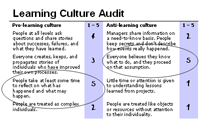 One way to begin the process of creating a learning culture and to enroll others in the effort is to conduct a learning culture audit. Recently I wrote about the benefits in a blog post entitled, “Resolution: This Year Create a Stronger, Smarter Organization.” A simple diagnostic can help you assess your organization and your management team’s orientation to learning. An assessment describes the characteristics of cultures that encourage learning and those that block learning. While my learning culture self-audit is not exhaustive and may not be in the form that will work best for your organization, it may help you assess how you are doing as a leader of a learning culture. Consider each question carefully and think about your behavior and that of your colleagues. You might also want employees to complete such a survey to get a sense of how they feel you and the entire organization are doing. [Printer-friendly version of the assessment.]
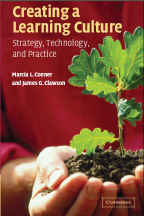 Creating a Learning Culture: Strategy, Technology, and Practice. Marcia Conner and James Clawson, editors (2004, Cambridge University Press). Creating a Learning Culture features insightful essays from industry observers and revealing case studies of prominent corporations. Each chapter revolves around creating an environment where learning takes place each day, all day—fundamentally changing the way we think about how, what, and when we learn, and how we can apply learning to practice. Three sections address key aspects of learning culture: the modern business context and the importance of learning at every juncture; the organic and adaptive approaches organizational leaders can take to design enduring success; and the expanding role of individuals within organizations and the implications for business leaders, educators, technologists, and learners. Identifying the steps companies must take to remain competitive for years to come, this book explains how learning strategies applied to all aspects of every job can provide swift returns and lasting results. Read the introduction [pdf] by John Seely Brown and Estee Solomon Gray and Chapter 1 from Harlan Cleveland.
As part of the fellowship, we hosted a 2-day colloquium at Darden that generated lively conversation and the surfacing of some core definitions around the topic still in use today. For that event, I worked with the Batten Institute team to develop a primer entitled, “Transforming Culture: An Executive Briefing on the Power of Learning.” Some of the papers included:
“A World of Magnificent Maniacs: Learning at WD-40” [.pdf] by Garry O. Ridge with Marcia Conner. Garry says that WD-40 Company doubled its earnings over six years by adding new products and creating a culture of learning within the company—a culture in which employees see themselves as learning maniacs, and mistakes are known instead as learning moments.
“At the Water Cooler of Learning” by David Grebow. David explains that we have become obsessed with formal learning in the workplace. In our zeal to learn, we have transferred the formal model of learning into the collective mind of our corporations. Even e-learning is simply less-expensive formal learning at a distance. We recently republished this piece on my blog.
“Learn by Doing: Get Faster Every Lap” by Jack Ring. The challenge in creating a team learning culture is to harmonize competition and collaboration. Many a highly talented person, fiercely dedicated to winning in competitions, simply cannot collaborate in doing, let alone in colearning by doing. Transforming a person’s values to team winning without suppressing the urge to innovate is key. Personal and group learning must meld into a specific “feel” that permeates the team.
“Why Communities are Vital to Learning” [pdf] by Rich Persaud with Gretchen Lee. There’s an old saying: “You don’t need to teach children how to learn; children have no choice but to learn.” The same is true for adults. We are learning machines on legs, each of us collecting an enormous amount of sensory data every day. The things you learn today interact in your brain with knowledge you’ve already stored away—and that learning goes on 24 hours a day, at the speed of light. The earlier you can get new information in your brain, the sooner it can start compounding with the knowledge that is already there.
“Evolutionary Learning at Revolutionary Speed” [pdf] by Joel Getzendanner. It happens a billion times every day. A seed falls to the ground. It waits for conditions to be right, and once they are, it begins its magic. Protoroots probe their surroundings, selectively absorbing the molecules they need. The roots pass the nutrients to the shoots as they reach for the sun. Leaves and branches form, and eventually a flower buds, then blossoms. Bees, butterflies, or insects may complete the pollination process. Deep inside the plant, molecules reorganize themselves into a seed, so that the cycle can repeat itself the following year. But not quite.
“The Value of Learning about Learning” [pdf] by Jay Cross and Clark Quinn. To foster a learning-to-learn culture, organizations must understand the unique elements that contribute to such a culture. There is a long list of elements against which organizations can be audited. They include valuing and fostering self-improve- ment, specifically learning. For example, does the organization create, keep, and propagate stories of individuals who have improved their own processes?
I’d be happy to also answer questions you have. Please send them directly to me or post in the comments below. Here’s to making 2013 a transformative year.

[Photo credit: Talk to the Hand, Swamibu via Flickr]