

We have become obsessed with formal learning in the workplace. In our zeal to learn, we have transferred the formal model of learning into the collective mind of our corporations. Even e-learning is simply less-expensive formal learning at a distance.
Our obsession began when we decided we were in the knowledge economy. We concluded that human assets are the most important element of our collective P&L. The only way to attract, improve, and retain those assets is to offer learning. Learning makes brains physically bigger. Learning also makes them smarter. Smarter translates into faster, newer, better, and more competitive. And the competitive advantage of smarter in a Darwinian business ecosystem eventually leads to more profits. If people in your company learn what your company needs to know and do, you can get smarter. You can have a higher corporate IQ than some other company, and you can win. The only problem is that we have very little idea how real learning occurs. We spend billions of dollars on formal training and education, and then we wonder, where is the payoff?
Sometimes people do learn. They change and improve. Performance temporarily increases. Mistakes on the production line start to decrease. Safety records seem to get better. But most of the time, it’s hard to see why anyone has bothered. Organizations provide the formal learning, but little changes.
Here’s a true story that may shed some light on the matter. I was working as a mailroom clerk (“mailboy” in those days) in a giant Boston insurance company, paying my way through college. The company had no formal mailboy-training program. I just walked around for an unspecified number of days with a senior mailboy, watching and learning, asking and listening. I was a young apprentice on the move. Then, one day, when I was deemed fit and ready, I walked around on my own. And if I had a question, I went over by the water cooler (yes, they did have them back then), where the mailroom supervisor waited. After a few moments of idle chitchat, I asked, trying not to look too dumb, “So, how do you refill that postage meter stamp thing?” From that moment on, I learned everything I really needed to learn by the water cooler.
Real learning, the kind of “aha!” moment that signals the brain has connected the dots, is an absolutely wondrous and amazing mystery. It involves memory, synapses, endorphins, and encoding, and, more often than not, those accidental and serendipitous moments we call informal learning. Most real learning—the kind that sticks to the walls of the brain—is informal. That’s true even in a formal setting such as a school. Informal learning is what goes on around our formal learning process. It’s a hitchhiker sitting unobtrusively in the back seat of the school bus—a place where pedagogy has yet to go. It’s the opposite of the shining and hallowed place where teachers, instructors, professors, and even graduate assistants proudly pontificate, as the Wizard of Oz did before his hot-air balloon took off for a star called Kansas.
Let’s step back here and define “formal” and “informal” learning. Formal learning happens when knowledge is captured and shared by people other than the original expert or owner of that knowledge. The knowledge can be captured in any format—written, video, audio—as long as it can be accessed anytime and anywhere, independent from the person who originally had it. Examples of such formal knowledge transfer include live virtual-classroom courses with prepared slides, self-paced off-the-shelf instructional CBT courses, books, video- and audiotapes, team rooms in which documents are stored, digital libraries and repositories, a real-time seminar on the Web (or webinar), electronic performance-support tools, programs accessed during a job or task, instructor- led courses that follow an outline, repeatable lecture labs, a recorded Web-based meeting, or even e-mails that can be forwarded. Formal learning often requires prerequisites, pre- and post-assessments, tests, and grades, and it sometimes results in certification. It is often presented by an instructor, and attendance and outcomes are tracked.
Consider the limits of formal learning in the workplace. Because of time and cost pressures, people who teach in the corporate environment often do not have the same relationship with learners as can be found in some of the more traditional school environments. In those increasingly rare places, teachers and learners can work together over time, and the formal and informal learning begin to blend. Once you are done with a course in a company, it’s quick back to work, with the assumption that your attendance has translated into knowledge. I recently chose a course only because the marketing brochure promised that learners would have unlimited and extended access to the instructor after the course to make sure we were applying what we learned. Such access was a first for me.
Informal learning is what happens when knowledge has not been externalized or captured and exists only inside someone’s head. To get at the knowledge, you must locate and talk to that person. Examples of such informal knowledge transfer include instant messaging, a spontaneous meeting on the Internet, a phone call to someone who has information you need, a live one-time-only sales meeting introducing a new product, a chat-room in real time, a chance meeting by the water cooler, a scheduled Web-based meeting with a real-time agenda, a tech walking you through a repair process, or a meeting with your assigned mentor or manager.
Virtually all real learning for performance is informal, and the people from whom we learn informally are usually present in real time. We all need that kind of access to an expert who can answer our questions and with whom we can play with the learning, practice, make mistakes, and practice some more. It can take place over the telephone or through the Internet, as well as in person. But if informal access is not built into the formal learning process, the chances of getting past knowing to doing will be difficult at best.
Here’s one of many examples. In the early days of the personal computer, we would all go to the same course to “learn” how to use an application or operating system, and then we would go back to our desks, usually with a thick how-to manual. The problem was that we never used those manuals. Instead, we found the local “power user,” the person who for one reason or another had spent more time playing with the computer, or had taken more courses, or had learned directly from an expert, and we began to pepper that person with phone calls and show up frequently at his or her doorway or cube entrance. Two things quickly became apparent. First, the power user was teaching what people had not managed to learn in the class, and second, the power user had learned how to use the PC in a very different way: what he or she showed you was often not the way it had been taught. But it was the time I spent huddled in front of the power user’s screen when I really learned the word processing and spreadsheet and graphics programs I needed in my work. My learning may have started in the course, but it ended in the huddle.
A study of time-to-performance done by Sally Anne Moore at Digital Equipment Corporation in the early 1990s, and repeated by universities, other corporations, and even the Department of Health and Human Services, graphically shows this disparity between formal and informal learning.
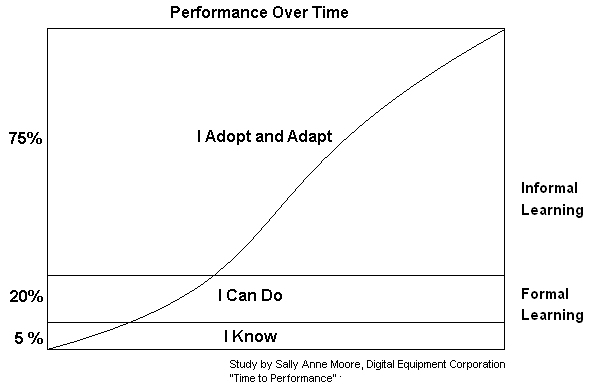
To illustrate the difference between formal and informal learning, let’s consider the game of golf. If you want to learn to play golf, you can go to a seminar, read a book about the history and etiquette of golf, watch a videotape of great golfing moments, and then you can say you know something about golf. But have you really learned to play golf? You can then buy and enjoy a great e-golf game, find a golf pro, take lessons, take a simulated swing on a simulated golf course, practice putting, slice and dice balls at the driving range all weekend. After all this, you think you can do it, but have you really learned to play golf?
From your first tee shot on your first hole, it takes hours of adopting and adapting, alone and in a foursome, in all sorts of weather and conditions. You discover what you know and can do, swing all the clubs, ask all sorts of questions, fail and succeed, practice and practice some more, before you have really learned to play golf. Real learning, then, is the state of being able to adopt and adapt what you know and can do—what you have acquired through formal learning—under a varying set of informal circumstances. It accounts for about 75 percent of the learning curve. In the mailroom, it was 100 percent of my learning curve.
I call this the 75/25 Rule of Learning. We get only about 25 percent or less of what we use in our jobs through formal learning. Yet the majority of companies are currently involved only with the formal side of the continuum. Most of today’s investments in corporate education are on the formal side. The net result is that we spend the most money on the smallest part of the learning equation.
The other 75 percent of learning happens as we creatively adopt and adapt to ever changing circumstances. It happens when we ask someone a question at the water cooler—and get an answer. So the informal piece of the equation is not only larger, it’s crucial to learning how to do anything. Do we take it into account when we think about teaching someone how to do something? Do we consider it in the workplace when we collectively spend billions of dollars on training, learning, and e-learning? Of the hundreds of corporate executives and managers I’ve spoken with and interviewed, the answer today is invariably no.
In the workplace, where everything is focused on performance and performance is everything, we need to add the informal piece into the equation for any real learning to take place. We need to factor those accidental, informal intersections of learning and performance into the process. That’s the whole point of what you are reading, what your eyes are taking into your brain, and hopefully what you are beginning to see and learn. We need to understand that the informal side of the equation requires real people in real time: mentors, coaches, masters, guides, power users, subject-matter experts, communities of practice. We need to foster informal moments of knowledge transfer.
How? There’s an old workplace joke that goes, “See that person? She’s the smartest person in the company. And do you know who is the next smartest? The person sitting next to her.” If we want to become smarter companies, we need to encourage informal learning. We need to create what I have been calling collaborative learning environments, where we seamlessly knit together formal and informal learning. We need to use technology to facilitate the informal as well as the formal transfer of knowledge by including expert locators, e-mail connections with instructors, real-time Internet meeting places, virtual-learning support groups, instant messaging, expert networks, mentor and coaching networks, personal e-learning portals, moderated chats, and more. We need to start taking advantage of the tools and technology that exist today and those coming online tomorrow. We need to create the 100 percent learning solution, in which the proscribed formal learning events and the serendipitous learning moments are given equal value.
Formal learning is only the beginning of the challenge, not the end. I think I’ll go back to the water cooler and see what else I can learn.
David Grebow lives in Northern California and heads KnowledgeStar. He was a founding Executive Core Team member of the IBM Institute for Advanced Learning, where his research focused on collaborative learning environments. David has an MS in communications from Boston University. He is author of A Compass for the Knowledge Economy Business: How-to Succeed in the New Knowledge Economy available on Kindle.
This article was originally published in “Transforming Culture: An Executive Briefing on the Power of Learning,” Marcia L. Conner and James G. Clawson (editors). June 2002. It is reprinted here with permission.
(c) 2002 The Darden School Foundation.
[photo credit: Watercooler by Alix May (asrai)]